

17 November 2026 · Ryan Smuts, Director
That was the core message of After the Vote: Finance, Property and Your 2027 Game Plan, the webinar Kris and I ran on 10 November. Here's a summary of what we covered, and why we'd encourage you to act before the December OCR decision rather than after it.
▶ Watch the full webinar recording
One point from the night sets the scene. Carded rates across the main banks sit within 0.03% to 0.20% of each other, so the rate alone rarely justifies the effort of switching. What separates the banks right now is everything else they'll offer you to move.
$18,000
in cash contributions from three banks, for one client's restructure
0.03–0.20%
the gap between the main banks' carded rates. The rate isn't the win.
The way your lending is set up often matters more than the rate on it. Many homeowners and investors we meet have a structure that made sense when they first bought, but no longer fits their life or their plans.
Common problems we see:
Refinancing is the natural point to fix these, and homeowners often have room to improve too. An offset or revolving credit account can put your savings to work against your home loan, and the right mix of fixed and floating can help you pay it off sooner. Moving some or all of your lending to a new bank lets you set this up properly, separate securities and untangle home and investment debt.
Kris shared a recent example. The client had their home and four rentals all cross-secured with one bank, with $2.4 million of lending. We moved the home to its own bank, so it's never tied to a rental. Two rentals went to a second bank, and the rental they're most likely to sell sits alone at a third bank, so a sale repays only its own loan. The fourth rental is now debt-free, to hold for income or sell with every dollar going to the client.
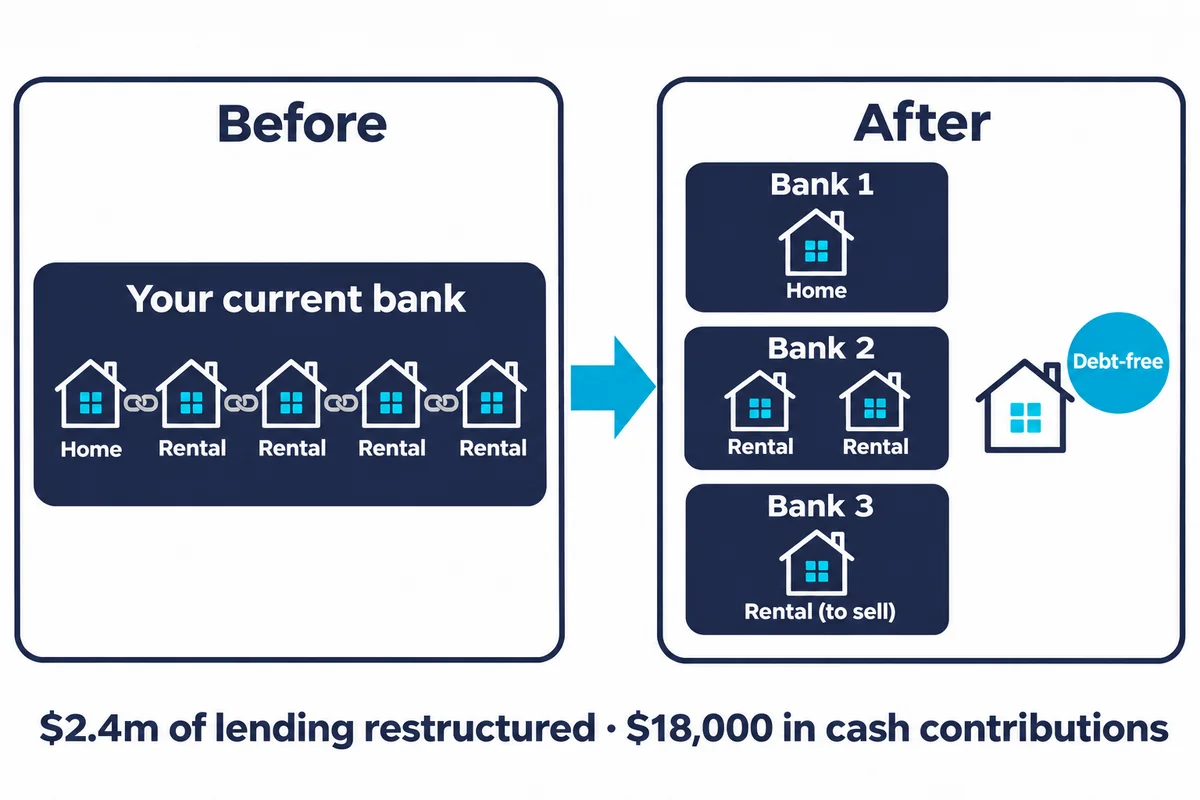
The result: the client controls the future sale, and three banks competed for the business, paying $18,000 in cash contributions between them.
Could your lending be set up better? We'll check your structure and what other banks would pay to win it. Book a review with our team →
Interest-only lending keeps your repayments down and frees up cashflow. For investors, it's often what makes holding a portfolio comfortable or buying the next property possible. For homeowners, a short interest-only period can ease the pressure through a tight patch, such as a renovation before selling, parental leave or a change in income. When an interest-only period ends, the loan rolls onto principal and interest, and repayments can jump sharply.
If your interest-only term is ending soon, or your current bank won't extend it, a new lender may offer a fresh interest-only period as part of a refinance. If you're on principal and interest today and would rather not be, refinancing can be the way to switch.
Check when your interest-only period ends. It's listed in the loan details for each split, and it isn't always the same date as your fixed-rate expiry. Some banks won't let you fix beyond your interest-only expiry, and banks are always changing their interest-only criteria, so knowing the date early gives you time to plan.
Each bank has its own appetite and terms for interest only, and these change. Part of our job is knowing which lenders will offer it for your situation right now.
Banks compete for good borrowers, and one of the ways they do it is with a cash contribution when you move your lending to them. At the time of our webinar, many banks were offering cashbacks of around 1% of the loan. On a $1 million mortgage, that could be as much as $10,000. It can cover the costs of switching, such as legal fees, and often leaves money left over to put toward your loans or a buffer.
Your bank's app (where they notify you it's time to refix and offer you a new rate) won't tell you this. Many people now refix with a tap on their phone, taking the rate offered without seeing what another bank would pay to win them. If your accountant is recommending a change of ownership structure, a refinance cashback can also help cover the cost of that restructuring.
Two things to keep in mind. Cash contributions usually come with a clawback, meaning you repay some or all of it if you leave the bank within a set period. And if you're partway through a fixed term, breaking it may cost a fee. We weigh both against the benefits before recommending a move, so the numbers stack up for you.
This is the most important point from the night. What you qualify for today may not be available after the next OCR rise. Here's why.
When a bank assesses a loan, it doesn't test your income against today's rate. It uses a higher "test rate" to make sure you could still afford repayments if rates rose. As the OCR goes up, banks' floating rates rise, and their test rates tend to follow. A higher test rate means the same income supports less borrowing. That can affect whether a bank will refinance you at all, offer interest only, or approve the structure you want.
At the time of the webinar, banks were testing borrowers at around 7%, even where the rate they'd actually pay was closer to 5.5%. The client in Kris's example shows how fine that line is:
| Same $2.4m of lending, same income | Monthly result at the bank's test |
|---|---|
| 21 years left on the loans, tested at 7.00% | $1,700 short: a likely decline |
| Loan terms extended to 30 years, tested at 7.00% | $536 of headroom: approved |
| 30 years, if test rates rise 0.50% to 7.50% | $278 short: a likely decline again |
Extending the loan terms turned a decline into an approval. A half-point rise in test rates would have put the client straight back into a decline. That's why we locked in the structure while the numbers still worked.
The OCR is already moving up. The Reserve Bank (RBNZ) raised it in July and again in September 2026, taking it to 2.75%. At its 28 October review it held at 2.75%, but only on a 4–3 vote, and all members agreed tighter policy is likely to be needed. The next decision is in December, with new forecasts, and the RBNZ expects inflation to rise to 4.4% in the December quarter. There's no OCR review in January, so after December the next decision is in February, and further increases into 2027 are a real possibility. When the OCR moves, bank floating rates usually move almost immediately, and test rates follow.
No one can say for certain where rates go next. But if the OCR rises again, the room to restructure, extend interest only or move banks may get tighter. Reviewing your lending now, while you have more options, puts you in control of the timing.
Time is short for 2026. Banks generally stop taking new pre-approval applications in early December and work only on live deals over the break. If you're planning to buy, get pre-approved now: approvals typically last 60 to 90 days. If any of your loans roll off their fixed term in the next six months, plan for it now. Refinancing at your refix date means no break fee.
Book a lending review with us before the December OCR decision. We'll look at how your current lending is structured, when your interest-only and fixed terms end, and what cash contribution is on offer from other banks. Then we'll show you whether a refinance makes sense, what it would cost, and what you'd gain.
The webinar also covered the election outlook, banks now lending up to 95% on owner-occupied homes and 90% on existing investment properties, and lending options outside the main banks (a fee may apply for non-bank lending).
If you missed the webinar, or want to talk through how it applies to your situation, book a lending review at www.krispedersen.co.nz.
Book a free, no-obligation review with our team. We'll check your structure, your interest-only and fixed-term dates, and what cash contribution other banks would offer. Banks stop taking new pre-approvals in early December, so get in before the Christmas close.
Or call the team on 09 486 4719 or email info@krispedersen.co.nz. Already working with a KPM adviser? Get in touch with them directly.
After the Vote: Finance, Property and Your 2027 Game Plan, with Kris Pedersen and Ryan Smuts, recorded 10 November 2026. Watch on YouTube.
This article is general information only and does not constitute financial advice. Lending criteria, interest rates, cash contribution offers and bank processing times are subject to change. Kris Pedersen Mortgages recommends you seek personalised advice from a licensed financial adviser before making any decisions about your home loan. General market commentary only — not personalised financial advice; talk to your adviser about your situation. OCR information as at 13 November 2026. Rates, cashbacks and bank policy as discussed in our webinar on 10 November 2026.