

When the property market goes quiet, it’s easy to assume buyers should sit tight too. Fewer people at open homes and less urgency around
buying can make waiting feel like the sensible option.
But a quieter market doesn’t automatically mean there’s less opportunity. For buyers who are financially ready, it may offer something
that’s harder to find when competition is strong: more breathing room.

Getting pre-approved for a mortgage can feel like a major milestone. You have supplied your information, the lender has reviewed your
position, and you now have an indication of how much you may be able to borrow.
It is certainly a valuable step. However, pre-approval does not always mean you can confidently make an unconditional offer on any property
within that price range.
There are still a few important pieces that need to fall into place

As widely expected, the Reserve Bank has increased the Official Cash Rate by another 0.25%, taking it from
2.50% to 2.75%.
This is the second consecutive increase following July’s move, with the Reserve Bank continuing to remove
monetary stimulus as it works to bring inflation back towards its 2% target.
Importantly, today’s announcement suggests the job may not be finished yet...........

For many Kiwi homeowners, refixing a mortgage can feel like a routine task. You choose a new interest rate, select a fixed term and move on.
However, your refix is also an opportunity to take a broader look at your mortgage and make sure it still suits your circumstances, cash
flow and future plans.

As you pay down your mortgage and the value of your property changes, you may build up equity in your home. That equity can sometimes be
used to help fund renovations, consolidate debt, invest or cover another significant expense.
One way to access it is through a home loan top-up. While this can be a cost-effective way to borrow, having equity
available does not automatically mean using it is the right move.
Here is what homeowners should consider before adding more to their mortgage.

Most of us have an everyday bank.
It’s where our salary or wages are paid, our bills come out, and our debit or credit cards are held. We may have been with the same
bank for years, so when it comes time to apply for a mortgage, it can feel natural to start there.
But does your mortgage actually have to be with the bank you use every day?
The short answer is no, not necessarily.

Most homeowners and investors set their mortgage up once and leave it there. But a home loan isn't a “set and forget” arrangement — and the
moments when your circumstances change are exactly when it pays to review it. One of the biggest of those moments is when you’re
restructuring how a property is owned: moving it into a company or a family trust. If that’s on your horizon, it’s also the ideal time to
look at whether your current bank is still the right fit.
The case for switching banks.....

For many homeowners, upgrading follows what feels like a familiar path.
Sell the current home, use the equity as a deposit, then move into the next one.
It's the approach most people expect.
But it's no longer the only option.

Buying your first home is exciting, but one of the biggest decisions you'll make comes before you even start house hunting.
Do you buy a brand new home, or an existing one?
Both options have their advantages. The right choice depends on your budget, your lifestyle and what matters most to you over the long term.
In this week's update, I'll walk through the pros and cons of each so you can make a more informed decision before taking
the next step.
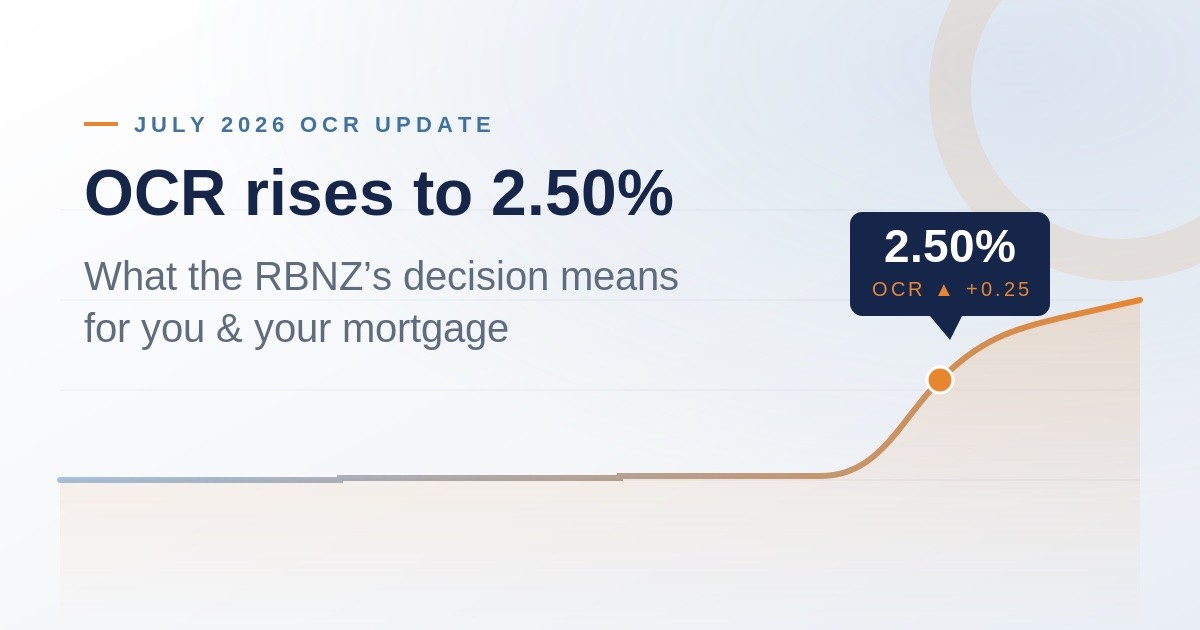
On the 8th of July the Reserve Bank of New Zealand lifted the Official Cash Rate (OCR) by 25 basis points to 2.50%, the first move in what looks set to be a gradual tightening cycle. The decision was reached by consensus, and while markets had largely picked a hike, a number of economists had backed a hold right up to the announcement.

Finding your next home should be exciting. Instead, many homeowners find themselves caught between wanting to secure the perfect property and worrying about what happens if their current home hasn't sold yet.

Most people assume their bank will tell them everything they need to know about getting a mortgage.
And to be fair, they'll absolutely help you apply for a loan.
But there's one important thing worth understanding.
Your bank can only advise on the products and policies available within their own organisation.
That means there may be options, strategies, or lender alternatives that never make it into the conversation.

Most people assume borrowing power comes down to one thing: income.
The common belief is simple. Earn more money and you'll be able to borrow more. While income certainly plays an important role, it's only
one piece of a much larger puzzle.

Saving a first-home deposit has become one of the biggest hurdles for buyers entering the property market.
While many people can comfortably service a mortgage, pulling together a sufficient deposit often takes years. That's why family support is
playing an increasingly important role in helping first-home buyers get across the line.

Live webinar. We're joined by two of Kiwibank's economists — Chief Economist Jarrod Kerr and Alexandra Turcu — for an honest hour
on where the New Zealand economy is actually heading.
Register now.

One of the biggest points of confusion for homebuyers - especially first home buyers - is the word “deposit.” One thing that catches a lot of buyers out is that there are actually two different types of deposits involved when purchasing a property.

If you're building a property portfolio in New Zealand, Loan-to-Value Ratio (LVR) restrictions are something you'll come up against at every
step. Set by the RBNZ, they cap how much banks can lend relative to a property's value — and they hit investors harder than owner-occupiers.
Below, we walk through the rules, the key exemptions, and a worked example.
1. What Is an LVR?
2. How LVR Is Calculated Across a Portfolio
3. Key Exemptions to LVR Restrictions
4. Case Study: Adding a Third Property
5. Scenario Comparison: 70% vs 80% LVR
6. Key Takeaways for Portfolio Investors

Inflation was forecast to ease. Then came the Iran oil shock — and now rate hikes are back on the table as early as December 2026.
On 12 May, Salesh Chand from GRA hosted Kris Pedersen and Than Sundar to talk through what that means for your mortgage, your
portfolio, and your next move.
Here are the key takeaways from the webinar........

Love Your Location…But Outgrown Your Home?
Not every homeowner needs to move, to move forward.
I’ve been having more conversations lately with clients in this exact position:
They love where they live.
The kids are settled.
The community feels like home.
But the house itself? It’s no longer working.
And that leads to the big question…

You've been watching the news lately, you'll know the conflict in Iran is more than a geopolitical story - it's a financial one that's starting to ripple all the way to New Zealand, including into your mortgage repayments.

Most mortgages aren’t set up based on strategy.
They’re set up based on what feels right at the time.
Right now, I’m seeing a lot of homeowners leaning toward short-term rates again.
Not because it’s always the best option -
but because they don’t want to “miss out” if rates drop further.
The reality?
This decision isn’t just about where rates are going.
It’s about how your mortgage is structured around your life.

Did you know you could buy an Electric Vehicle (EV) with a bank loan at 1% interest...?

The OCR (Official Cash Rate) has held again - and it’s triggered the same question I’ve been getting from clients this week:
“Should I break my fixed rate early to lock in something lower?”
It’s a fair question.
But it’s also where a lot of people get this wrong.
Because while a lower rate sounds like a win… it doesn’t automatically mean you’ll be better off.

Check Fund Smarter: How to borrow more, be tax efficient, & protect what you've built

If you’ve owned your home for more than a few years, you might be sitting on a "hidden" deposit without even realising it. While 2025 was a year of stabilisation, the March 2026 Cotality report confirms a fundamental shift. We are seeing a unique alignment of stars for Kiwi homeowners: 100% tax deductibility is back, interest rates have eased, and equity built up over the last five years is ready to be put to work.

Rising global tensions tied to actions by the United States—particularly the escalation of conflict involving Iran—are starting to hit closer to home for New Zealanders. While the situation may seem far away...

From renovating a bathroom or kitchen, to roofing and landscaping, the ANZ Reno Loan top-up can be for loan amounts of $3,000 to $50,000...

Most homeowners assume they’re stuck with their current mortgage rate until their fixed term ends.
That’s not always true.

If you’ve been scrolling through property listings lately, you know the "perfect" homes come with a massive "perfect" price tag. As a Mortgage Adviser, I’m seeing more and more Kiwis win by taking a different path: Buying the house that needs a bit of love. In 2026, "Sweat Equity" - trading your weekend DIY hours for actual bank balance growth - is the smartest way to get your foot in the door. Here is how the strategy works in plain English.

Most homeowners haven’t reviewed their mortgage since the day they signed it - and that could be quietly costing them thousands.
We’re a few weeks into the new year and while many of us have set goals around health, career, or lifestyle, there’s one area
that often gets overlooked:

We’ve officially kicked off 2026, and for many first-home buyers, the conversation has shifted. It’s no longer about "one day" or "eventually", it’s about being in the best possible position to move when the right house hits the market.
When it comes to money, sticking with what you know feels good. Many of us have banked with the same institution since we were teenagers.
It’s familiar, convenient, and feels like the simplest path forward.
So when it’s time to get a mortgage - often the biggest financial commitment you’ll make - heading straight to your bank can
feel like the natural next step.

A mortgage. A car loan. A credit card balance. Juggling multiple high-interest debts alongside your home loan is stressful and expensive.
Many homeowners don't realise they are sitting on the most powerful tool to fix this: their mortgage.
Consolidating your debt into your home loan isn't just a "life hack" for those in trouble; it's a smart, proactive financial strategy. It’s
about taking a messy pile of bills and reshaping it into one simple, manageable payment at a much lower interest rate.

With energy bills and transport costs remaining a top concern, many homeowners are looking for ways to make their homes warmer and cheaper
to run.
The good news is that banks are making this easier and more affordable than ever.

Buying bare land to build on is a fantastic goal, but it's a very different financial journey than buying an existing house.
The deposit rules are stricter, the loan types are different, and the process is far more complex. In this article, I'll walk you through
the essentials so you can start your building journey with confidence.

When it comes to getting a mortgage - the default option is to walk straight into your main bank. It feels safe, familiar, and easy.
But the most important question is: are you actually getting the best deal, or just the most convenient one?

For the past few years, anyone trying to buy their first home could be forgiven for feeling hopeless. We've seen a frantic seller's market,
sky-high prices, and then a rapid spike in interest rates that crushed affordability.
But the market has shifted.

After a period of rising costs, seeing interest rates begin to fall is a welcome relief for homeowners across New Zealand. While it’s
tempting to simply enjoy the extra cash in your account, this moment presents a powerful strategic opportunity to either improve your cash
flow or significantly accelerate your journey to being mortgage-free.
But what's the right move for you? It generally comes down to two common scenarios.

It’s the most common question I get from aspiring homeowners: "Do I really need a 20% deposit to buy a property?"
The short answer is no, but it certainly helps. While a 20% deposit is the traditional "gold standard," it's important to
understand why it's so beneficial, and what your options are if you're not quite there yet.

More first home buyers are getting into the market by choosing 'do-up' properties and building value through their own work - often called
'sweat equity'. With first-timers now making up around 26% of all buyers, it's clear this hands-on approach is working.
Buying a home that needs work isn't just a cheaper option; it's a smart financial strategy. However, before you start planning any
renovations, it's vital to understand the costs, the risks, and the overall game plan.

Buying your first home in today's market comes with a unique set of challenges and, understandably, a lot of questions. As Mortgage Adviser’s, we see the same concerns come up time and again.

Figuring out which home loan product to choose can be confusing, especially with so many options available.
Deciding between a Revolving Credit or an Offset Facility is an important decision that can significantly influence your financial strategy.

Being self-employed often comes with the freedom to build your business on your terms - but when it comes to getting a mortgage, it can
sometimes feel like you’re speaking a different language to lenders.
The good news? More and more banks and lenders are starting to understand how self-employed income works. And with the right advice and
preparation, you can absolutely make your homeownership goals a reality.
Mortgage test rates are experiencing their most significant drop in recent years, unlocking additional borrowing power specifically
benefiting first home buyers and existing homeowners alike.
In this week’s update we’ll take a look at how the increased borrowing capacity significantly impacts potential homebuyers,
creating new opportunities in a previously challenging market.

Many New Zealand homeowners are looking for better ways to manage their mortgages. A revolving credit facility can be a powerful tool to help you pay off your home loan faster while giving you access to your home’s equity when you need it. So in this week’s update, we’ll help you understand how a revolving credit works and whether it might be the right strategy for your financial situation.

Planning to buy a home this year? You might be wondering if your recent holiday spending could hurt your home loan application. The good news: it probably won’t. In this week’s update, we’ll explain why you don’t need to cancel the fun to stay on track for your 2025 property goals.

Non-bank lenders are financial institutions that provide loans without holding a banking licence from the Reserve Bank of New Zealand. While they’re sometimes referred to as “second-tier” lenders, this terminology actually undervalues the significant role they play in the lending space.

Deciding whether to refix or refinance your mortgage can seem like a daunting task, especially when your fixed interest rate is about to
expire.
The decision will largely depend on your current financial circumstances, the prevailing market conditions, and the potential advantages of
switching lenders.

When it comes to home loans, not all banks view and assess an application in the same way. They all have varying policies and criteria. Things like self-employed income, overseas income, variable (bonus, commission etc.) income, or rental income and multi ownership structures may be treated differently, directly affecting the amount you can borrow.

Attending an auction can be an overwhelming experience.
With so much pressure to make the right decisions, it's easy to get caught up in the excitement and lose sight of your goals.

Whether you're a first-time buyer or an experienced investor, knowing how each sale and purchase method works can help you make an informed
decision. In this week's update, we'll explore the different ways to purchase property, providing you with valuable insights to help you
navigate the process successfully

Private sales, also known as a private treaty, offer a unique opportunity to buy directly from the property owner.
While this approach can potentially save you money, it also comes with its own set of challenges, especially when it comes to securing your
financing.

I answered the phone last week with an excitable business development manager of a non-bank lender on the other end who knew that we deal a lot with property investors and who wanted to let us know their latest mortgage updates...

As a mortgage adviser, I’ve witnessed firsthand how strategic mortgage refinancing can create significant financial opportunities for
homeowners.
With the Official Cash Rate (OCR) now at 3.75% and showing a downward trend, many people are wondering if now is the right time to
refinance.

Understanding the process of going unconditional on a property is an important step in the journey of home ownership or property
investment. This milestone signifies your commitment to the purchase, but it also requires careful financial readiness.

As a first home buyer, you're probably aware that you can use your KiwiSaver to help with your deposit. But how do you actually get that money out in time? In this week’s update, we’ll break it down step-by-step to ensure you're not caught short when it's time to pay your deposit.